

SEO Migration Services That Protect What You Have Already Earned

A redesign, a replatform or a domain change can undo years of search visibility in a single launch. The traffic does not always fall on day one, which is what makes it dangerous. We plan and run the SEO side of your migration so your rankings, your organic traffic and your enquiries survive the move.

What Is SEO Migration

What Is Enterprise SEO?

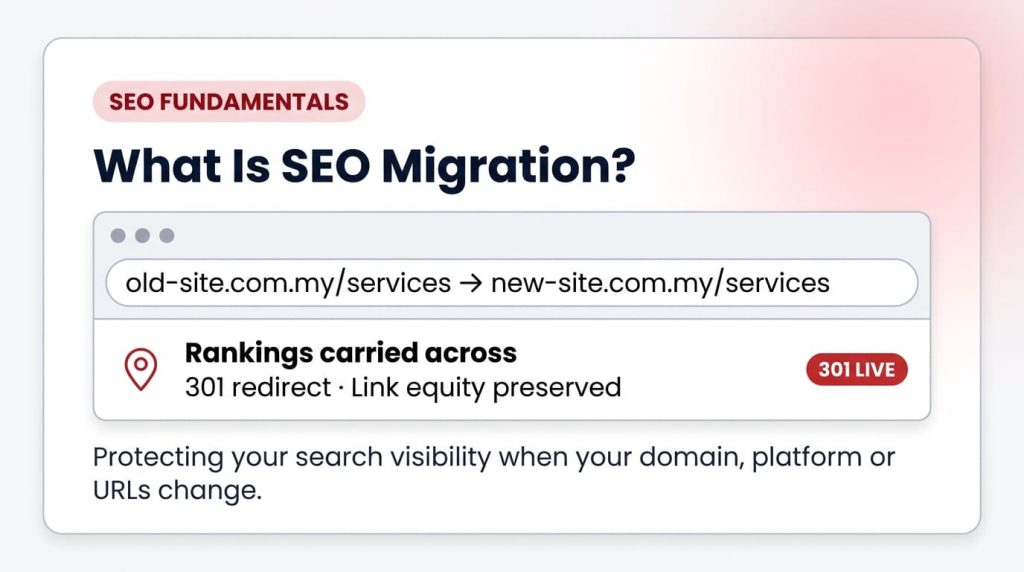
SEO migration protects a website’s search visibility when it changes domain, platform, design, or URL structure. It covers a pre-launch baseline, a complete redirect map from old URLs to new, preservation of link equity, and post-launch monitoring. It is different from server or hosting migration, which moves files and data but does nothing to protect rankings.

SEO Migration Is Not the Same as Server Migration

This is the single most common and most expensive misunderstanding in Malaysian website projects. Both are called migration, and clients book them as the same job. They are not.

Server or hosting migration SEO migration
Moves files, databases and email to new infrastructure Protects rankings, organic traffic and enquiries through the change
Success means the site loads and nothing is broken Success means Google still understands the site and your positions hold
Handled by a hosting provider or web developer Handled by an SEO team working alongside the developer
Finishes at launch Runs from baseline through launch and on through recovery monitoring
No redirect strategy, or redirects added reactively when errors appear Complete redirect map built and tested before launch, old URL to new URL
Link equity is not considered Link equity from existing backlinks is deliberately carried across

A hosting migration done well still loses rankings if nobody mapped the URLs. If your web developer has quoted for a migration, it is worth asking which of these two jobs they are actually doing.

When You Need an SEO Migration

Any change to the addresses, structure or platform of your site is a migration in Google’s eyes, even when the business calls it something else.

Type of change What is really happening
Website redesign Templates, headings and internal links change, often with new URLs. The most frequently underestimated risk
Replatform or CMS change Moving to WordPress, Shopify, WooCommerce or a custom build. URL patterns usually change wholesale
Domain change or rebrand Every URL on the site changes at once. The highest risk migration of all
URL restructure Changing folder structure, category paths or slugs while staying on the same domain
HTTP to HTTPS Technically a full URL change for every page on the site
Site consolidation Merging several sites or subdomains into one, or splitting one into several

Why Rankings Usually Drop Weeks After Launch, Not On Launch Day

Most teams check analytics the morning after go-live, see traffic holding, and conclude the migration went well. The damage from a bad migration is rarely visible that early.

Google has to recrawl the site, follow the redirects, and reassess every page before positions adjust. On a small site that takes days. On a large one it can take weeks. The decline often starts three to four weeks after launch, by which point the developer has closed the project, the team has moved on, and nobody connects the drop to the migration that caused it.

That delay is precisely why migration SEO has to be planned before launch. Once positions have fallen and the old URLs have been deindexed, recovery is slower and more expensive than prevention would have been.

Why Rankings Usually Drop Weeks After Launch

Pre-Launch Baseline

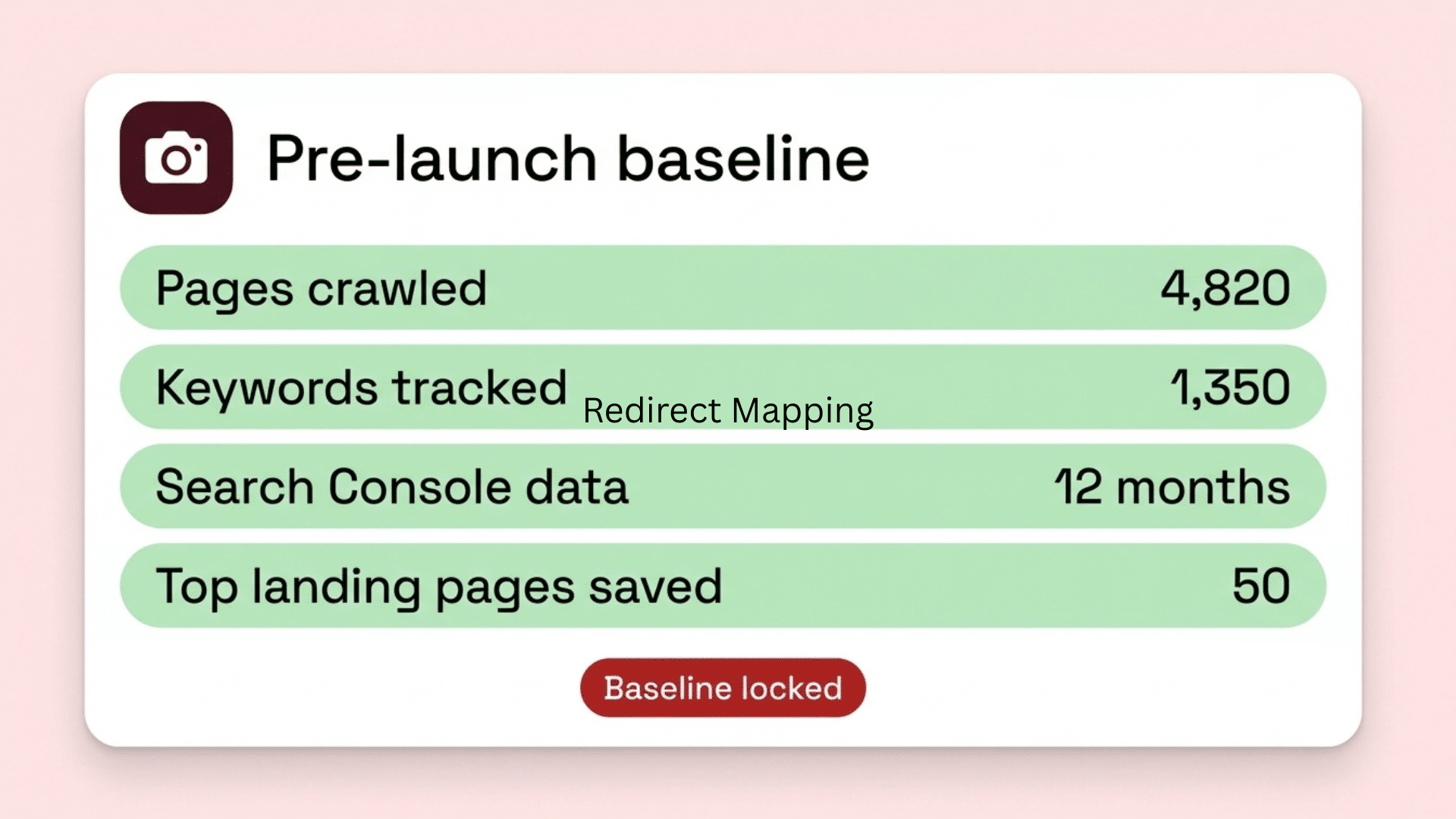
Before anything changes, we record where you stand. That means a full crawl of the current site, your ranking positions, your top landing pages by traffic and conversions, and an export of up to twelve months of Google Search Console data. Without a baseline there is no way to prove what was lost or recovered, and most migrations have none.
Pre-Launch Baseline

Redirect Mapping

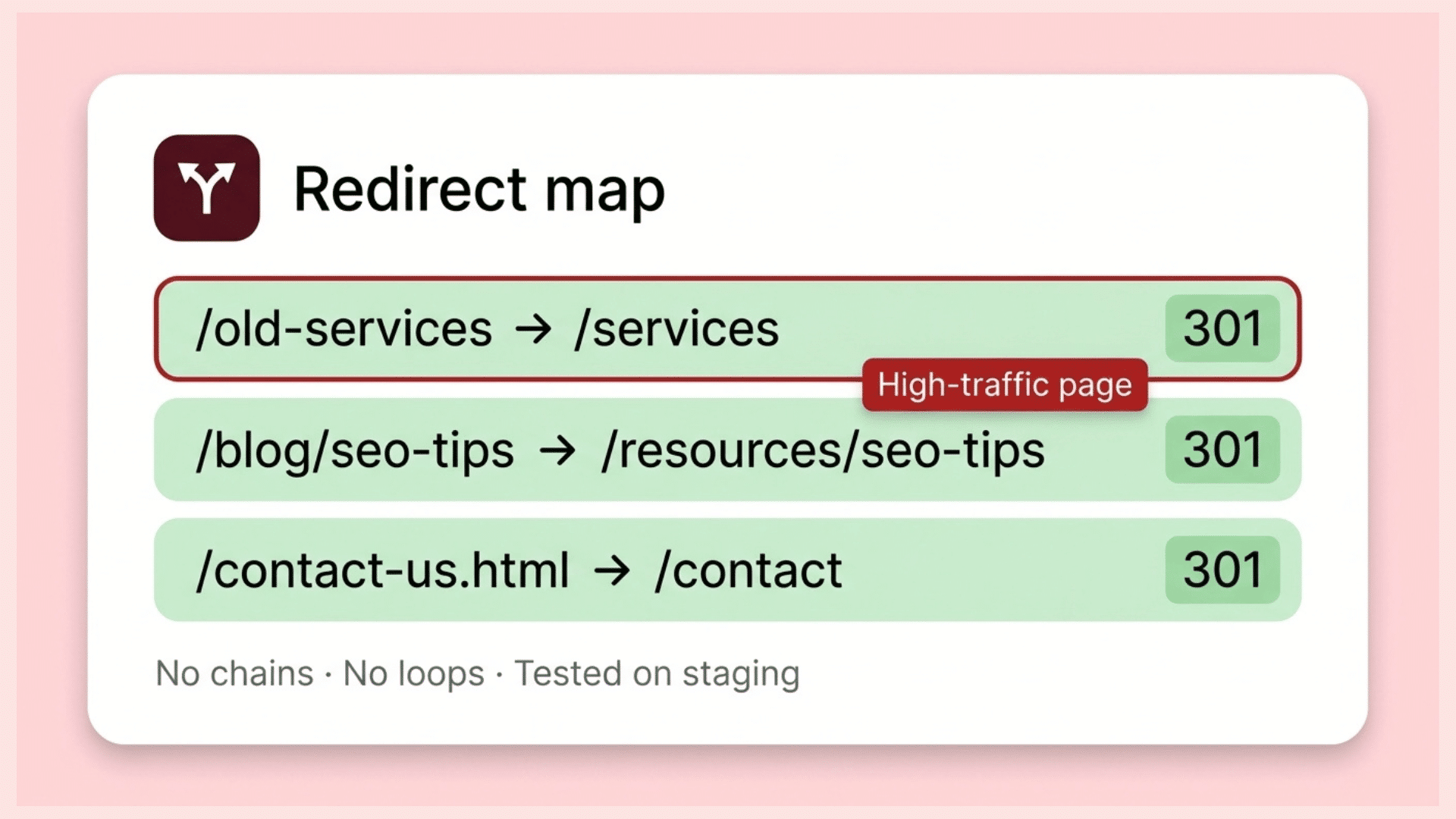
Every old URL is mapped to its closest match on the new site and implemented as a permanent 301 redirect. We prioritise the pages that carry traffic, rankings and backlinks, avoid chains and loops, and test the whole map on staging before launch rather than fixing errors afterwards.
Redirect Mapping

Link Equity Protection

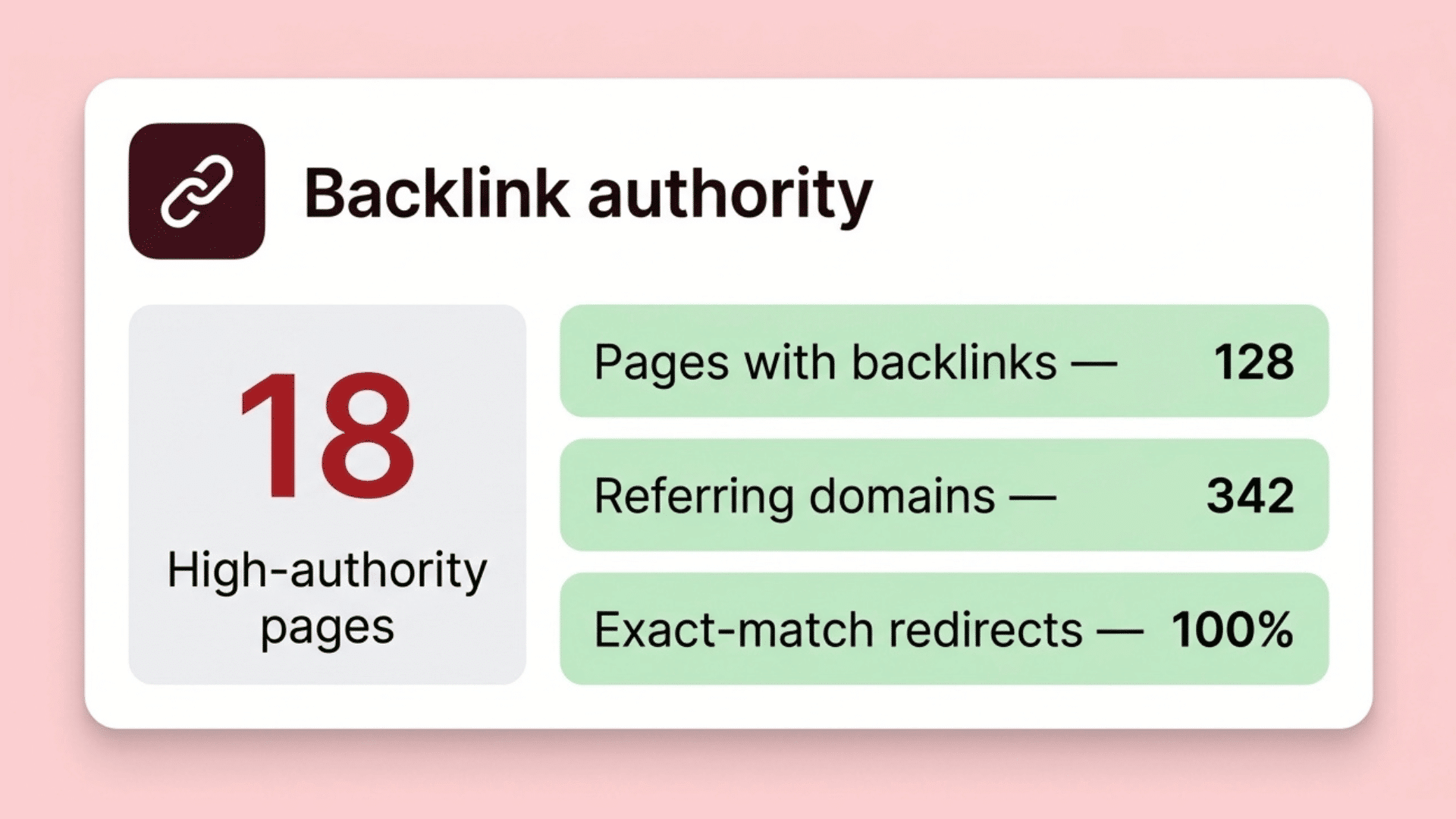
The backlinks pointing at your old URLs are the hardest part of your SEO to rebuild, and they are what a bad migration wastes. We identify which pages carry real external authority, make sure those redirects are exact rather than approximate, and follow up with important referring sites where a direct link update is worth requesting.
Link Equity Protection

Staging Review Before Go-Live

We review the new site while it is still on staging: indexability, robots rules, canonical tags, page titles and headings, structured data, internal linking and page speed. This is also where we check that the new build has not quietly dropped content that was earning traffic on the old site. It is the same discipline as our technical SEO work, applied under a deadline.
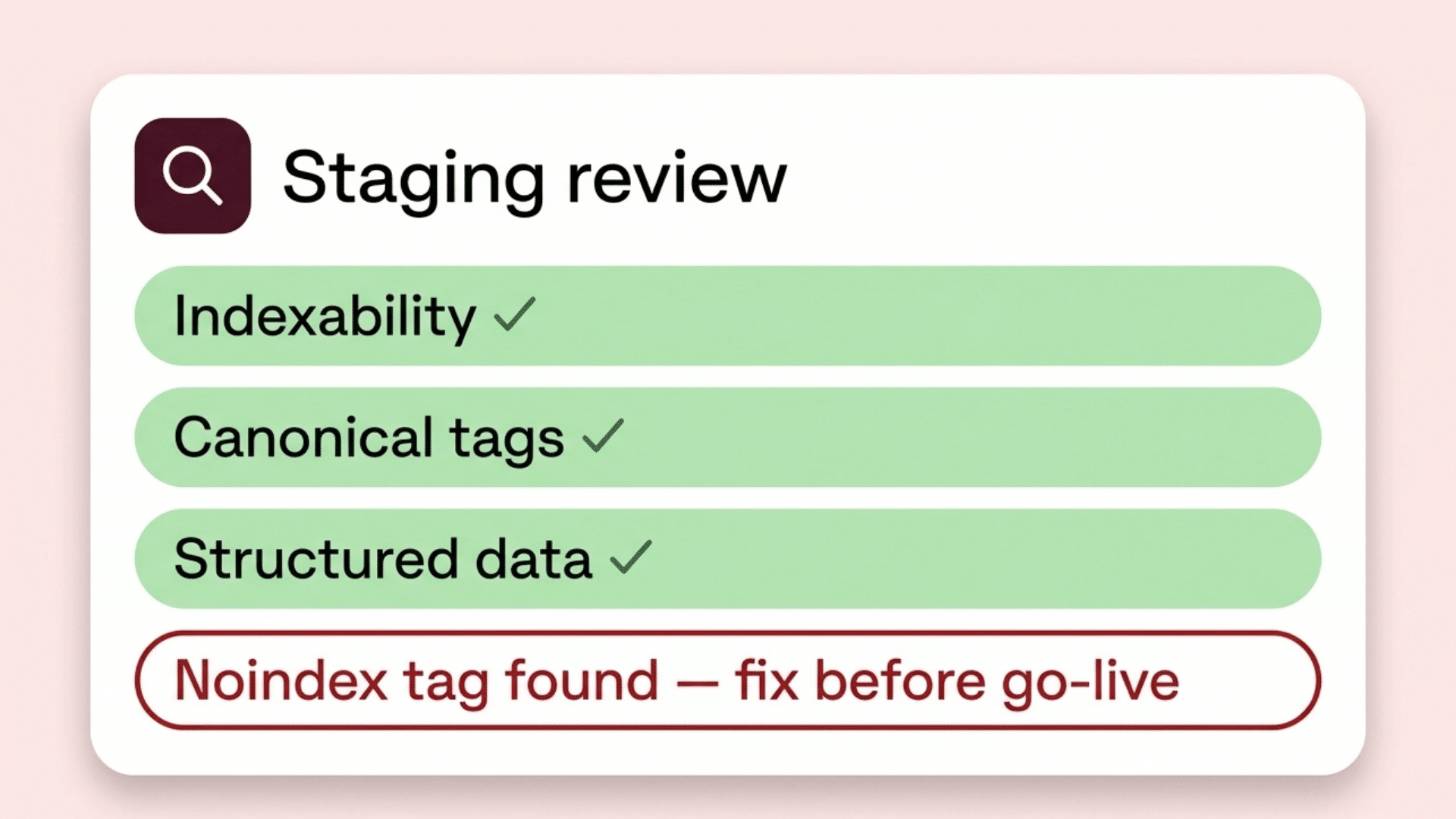
Staging Review Before Go-Live

Launch Day Checks

On go-live we confirm the site is indexable, the redirects are firing correctly, the robots file and sitemaps are right, and analytics and Search Console are tracking the new URLs. Catching an accidental noindex on launch day costs an hour. Catching it three weeks later costs a quarter.
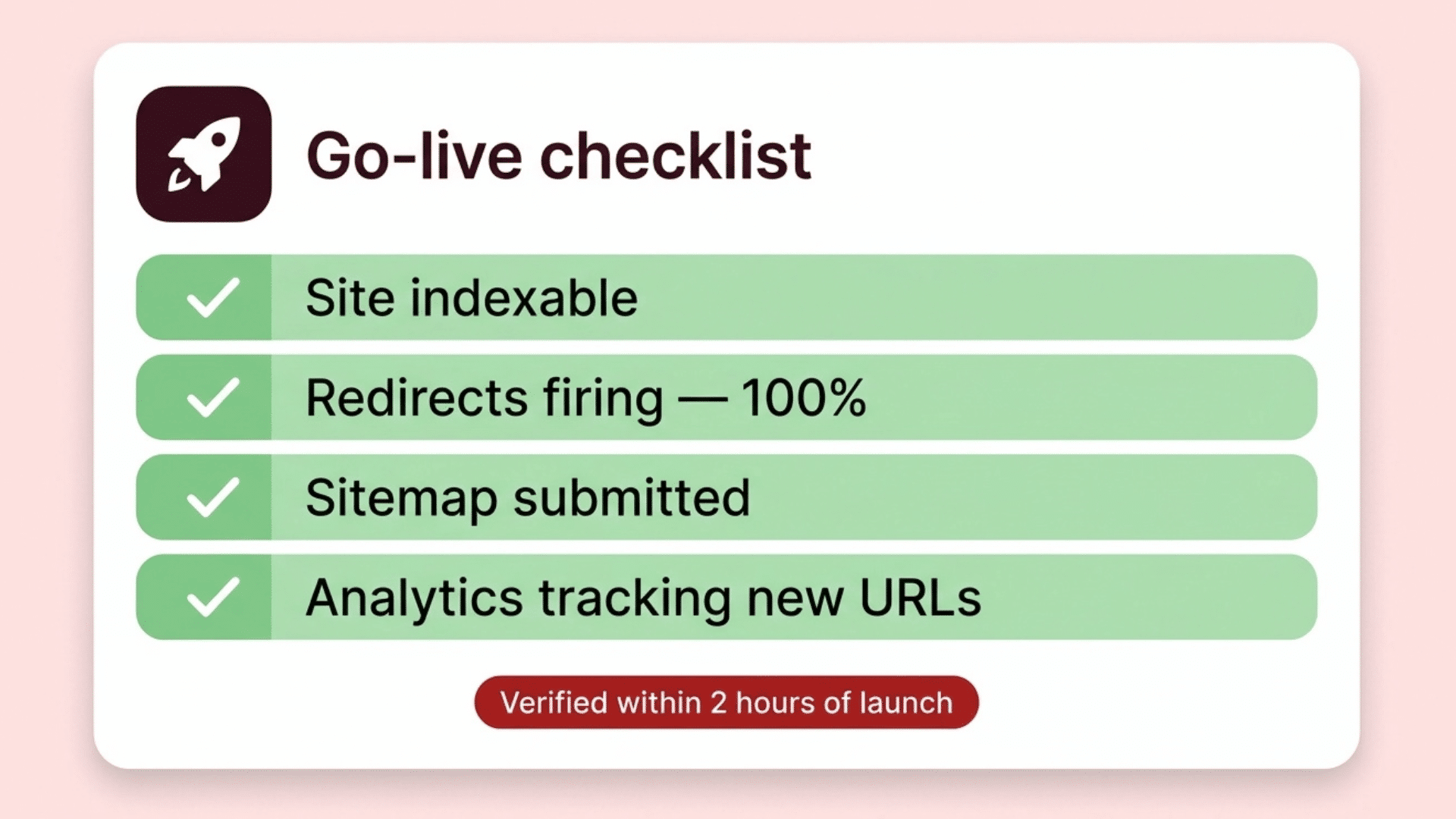
Launch Day Checks

Post-Launch Monitoring and Recovery

We monitor crawl errors, indexation, rankings and traffic against your baseline for the weeks that follow, because that is when problems surface. If something moves the wrong way we find the cause and fix it while it is still cheap to fix.
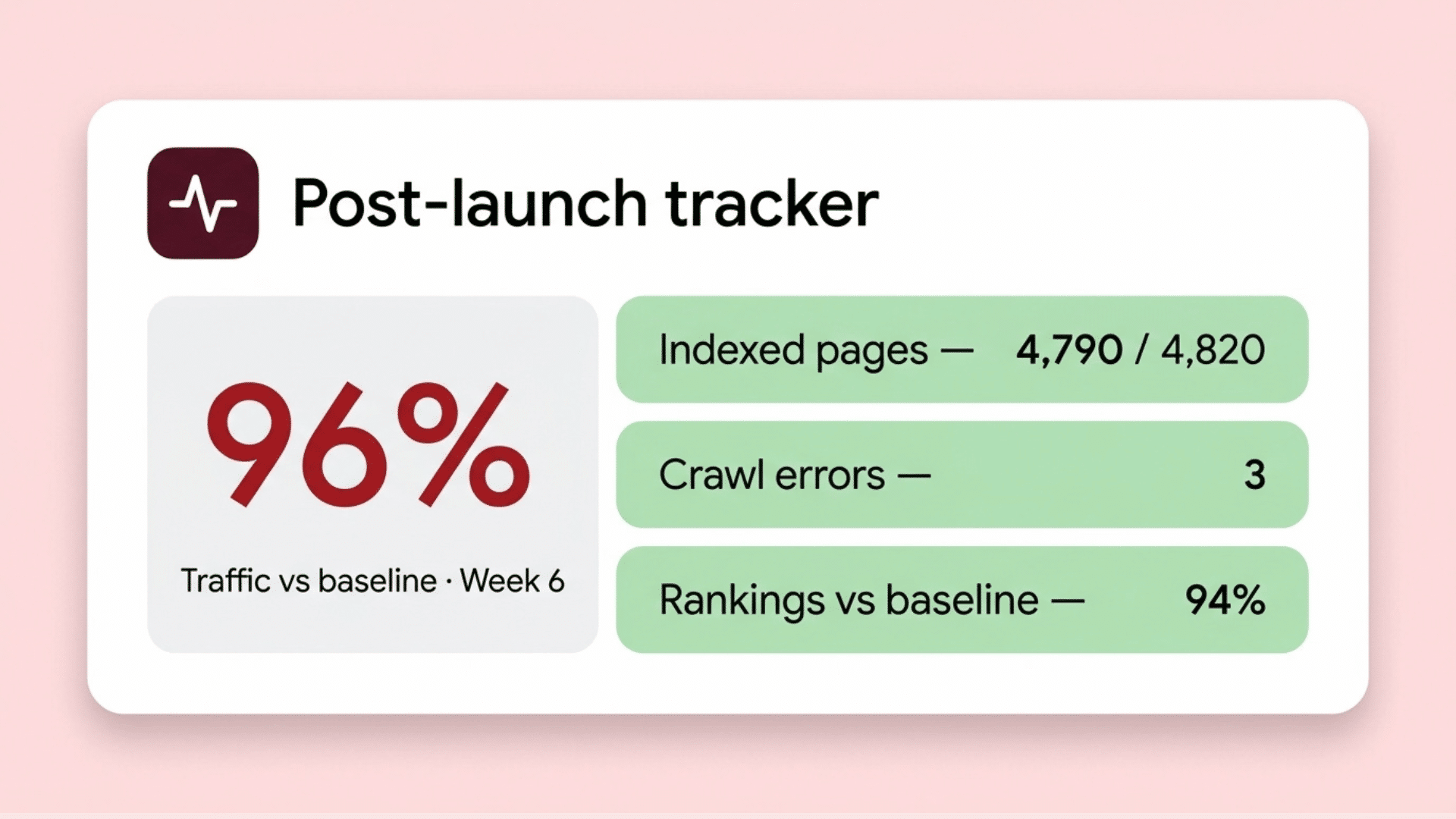
Post-Launch Monitoring and Recovery

Protecting AI Search Visibility

A migration can cost you more than rankings now. If your pages are cited in Google AI Overviews or referenced by AI assistants, broken URLs and lost structure can remove those citations too. We carry structured data and answer-first content formatting across to the new site so your AI visibility moves with you.
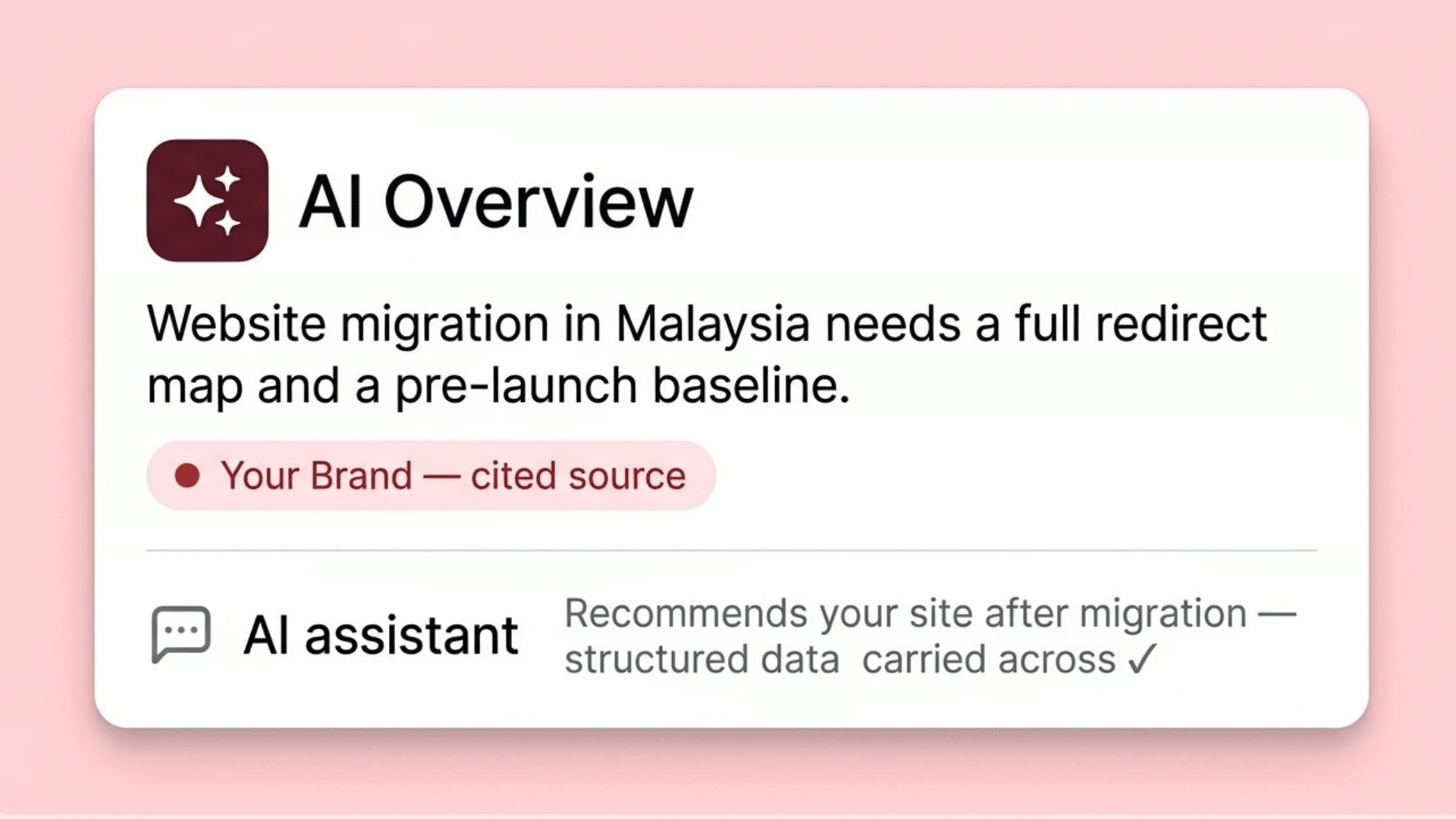
Protecting AI Search Visibility
How We Run a Migration

How We Run a Migration

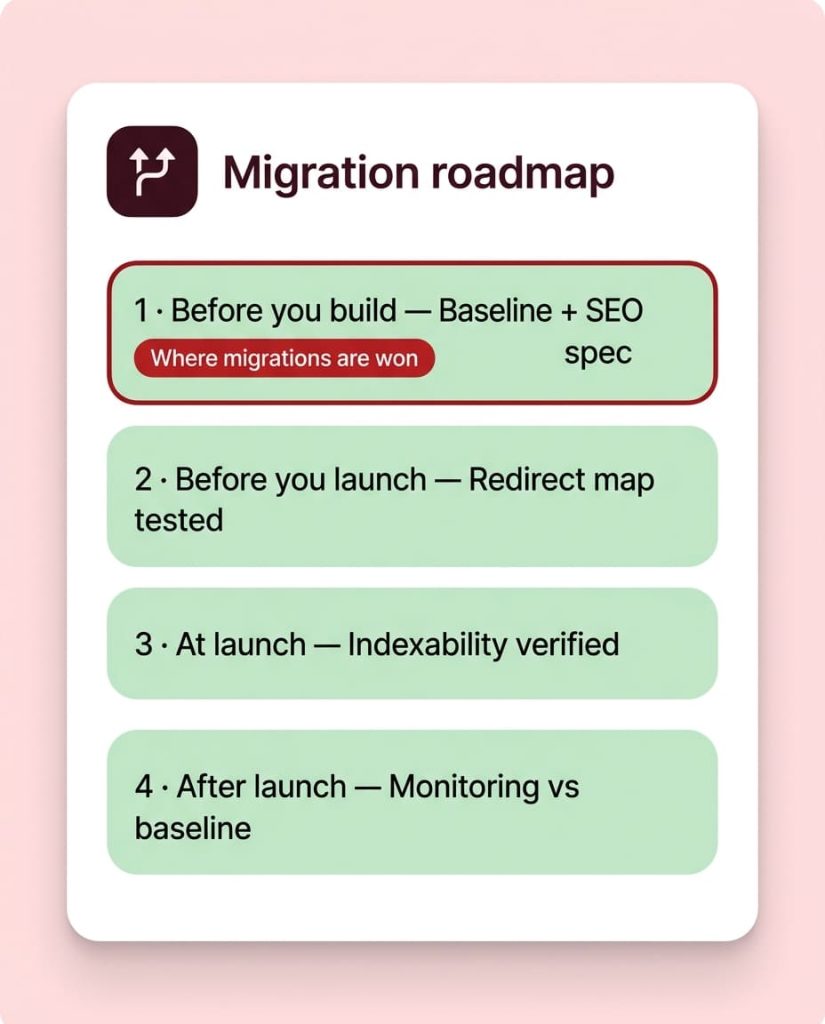
  1. Before you build. We agree scope, record the baseline, and give your developer a written SEO specification for the new site covering URL structure, redirects, metadata and structured data. This is the stage where migrations are won.
  2. Before you launch. We build and test the full redirect map, review the new site on staging, and sign off the checks that must pass before go-live.
  3. At launch. We verify indexability, redirects, robots rules, sitemaps and tracking within hours of the site going live, and submit the new structure to Google.
  4. After launch. We monitor rankings, indexation and crawl errors against the baseline and report honestly on what moved, what recovered and what still needs work.

What to Expect After the Move

Even a well-run migration usually sees some short-term movement while Google reprocesses the site. Anyone promising no change at all is not being straight with you.

Period What normally happens
Week 1 to 2 Google recrawls and reindexes. Rankings may fluctuate. This is expected and not a cause for panic
Week 2 to 4 Positions begin settling. A well-planned migration holds steady here. An unmanaged one starts to slide
Week 4 to 12 Recovery and stabilisation for most sites. Larger sites with more URLs take longer
Beyond 12 weeks If traffic has not recovered by now, something structural is usually wrong and needs diagnosis rather than patience

Why Work With Us on Your Migration

  • We start before the build. We plan the redirect map and the SEO specification before your developer builds, which is when a migration is actually won or lost.
  • Baselines, not guesswork. Rankings, traffic, conversions and backlink value are recorded before the move, so recovery can be measured rather than guessed at.
  • Deep dependency on technical SEO and on-page structure, which is what a migration actually stresses.
  • Straight answers. We tell you honestly what will move, roughly when, and what recovery looks like. No promises of zero impact.
  • We stay past launch. We watch the weeks after launch, which is when migration problems actually appear, rather than closing the project at go-live.
Why Work With Us on Your Migration

Migration Pricing

Migration scope depends on the size of your site, how many URLs change, and whether we are engaged before or after the build. We quote each migration on scope rather than publishing a flat rate that would not fit anyone. For ongoing search work after the move, see our SEO packages, or get in touch for a migration quote.

Planning a Redesign, Replatform or Domain Change?

Talk to us before the build starts. We will review what you are planning, flag the risks specific to your site, and tell you what needs to be in place to protect your rankings.

Frequently Asked Questions

SEO migration is the work of protecting a website’s search visibility when it changes domain, platform, design or URL structure. It covers recording a pre-launch baseline, mapping every old URL to its new address, preserving link equity from existing backlinks, and monitoring rankings after launch until the site stabilises.

No. Server or hosting migration moves your files, databases and email to new infrastructure, and it is finished when the site loads correctly. SEO migration protects your rankings and organic traffic through the change. A hosting move done perfectly can still lose your rankings if nobody mapped the URLs.

Some short-term movement is normal while Google recrawls and reprocesses the site. With a complete redirect map and a proper pre-launch review, most sites recover within four to twelve weeks. Without one, losses can be severe and sometimes permanent.

Before the new site is built, not after it launches. The redirect map and the SEO specification for the new build are what protect your traffic, and both need to exist before development finishes. Bringing in SEO after launch means recovering lost ground instead of protecting it.

Because Google needs time to recrawl the site, follow the redirects and reassess every page. Declines often begin three to four weeks after launch, long after the project has closed, which is why the cause is frequently missed. It is usually a redirect, indexation or content issue that can still be diagnosed.

Every URL that has traffic, rankings or backlinks needs one, and the safest approach is a complete map. Pages with no value can be consolidated sensibly, but guessing which ones matter without checking the data is how link equity gets thrown away.

Yes. If your pages are cited in Google AI Overviews or referenced by AI assistants, broken URLs and lost page structure can remove those citations along with your rankings. We carry structured data and content formatting across so AI visibility moves with the site.

Usually yes, though it is harder than prevention. We audit what happened, find the missing or broken redirects, check indexation and compare the new site against what the old one ranked for, then rebuild what can be recovered. The sooner after the drop, the better the outcome.